

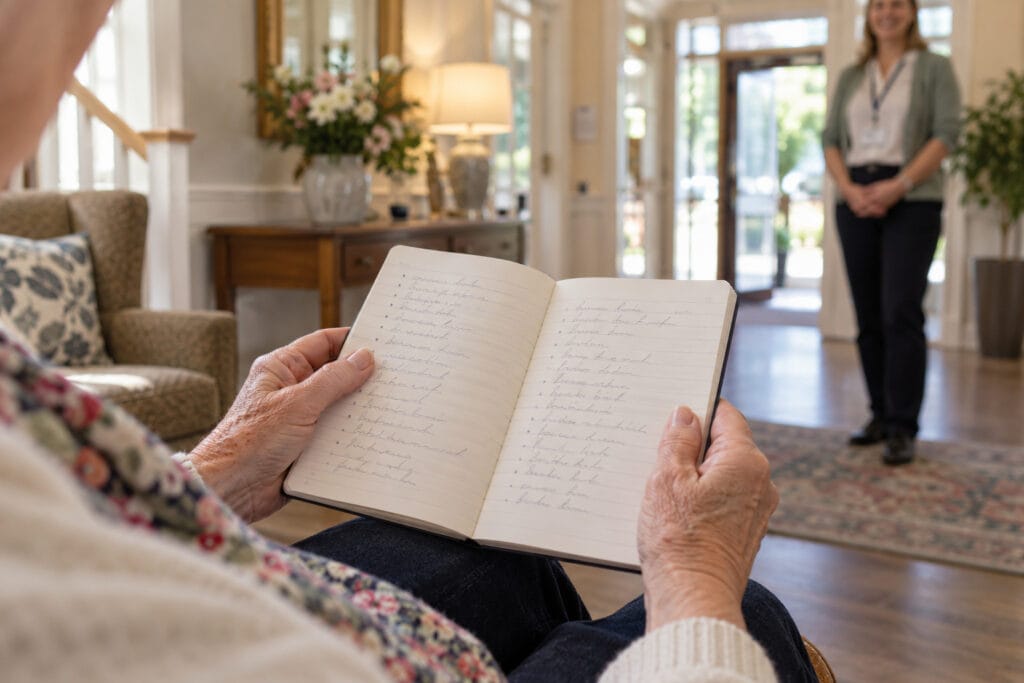
There’s a particular kind of blankness that happens on a care home visit. You’ve prepared a mental list of things to ask. You walk in, someone shows you round, everyone’s friendly, and somehow you leave forty minutes later having asked about the parking and forgotten everything else you meant to say. It happens to almost everyone. This is the list to take with you so it doesn’t happen to you.
None of what follows is specific to any one provider. It’s meant to work whichever homes you’re comparing.
Questions about care and staffing
How are staffing levels decided, and do they change at night? A reasonable, confident answer here tells you a lot about how carefully a home thinks about this.
What training do staff receive, and how often? Look for an answer that goes beyond a one-off induction — ongoing training matters more than a single certificate.
How is my relative’s care plan put together, and how often is it reviewed? [INTERNAL LINK: What Happens During a Care Needs Assessment?] A good home should be able to describe this clearly, including how families can stay involved over time. [INTERNAL LINK: Keeping Care Plans Alive: Why Reviews Matter as Much as the First Assessment]
What’s the CQC rating, and when was the last inspection? [INTERNAL LINK: Understanding CQC Ratings: What They Actually Mean] It’s worth asking to see the full report, not just the headline rating.
How does the home handle medical emergencies or a hospital admission? [INTERNAL LINK: What Happens If a Resident Needs Hospital Care?]
Questions about daily life and activities
What does a typical day actually look like? [INTERNAL LINK: A Day in the Life in a Lenore Care Home] Ask for specifics rather than accepting a general “we keep people busy.”
How personalised is the activities programme? A single fixed schedule for every resident is worth noticing as a red flag; genuine flexibility around individual interests is a good sign.
How is food handled — can dietary needs and personal preferences both be accommodated? [INTERNAL LINK: Behind the Scenes: A Day in the Kitchen]
What outdoor space is available, and how often do residents get outside? Facilities vary considerably between homes, so it’s worth asking directly rather than assuming.
Questions about fees and paperwork
What’s included in the weekly fee, and what’s charged separately? [INTERNAL LINK: Care Home Fees Explained: What’s Included and What Isn’t] Ask for this in writing before committing to anything.
How and when are fees reviewed, and how much notice would we get of a change?
If my relative is eligible for local authority support, how does that work in practice? [INTERNAL LINK: Self-Funded, Local Authority or Direct Payments: Understanding Care Funding]
What happens to fees during a hospital stay or a period away from the home? This is a detail some families are surprised by later, so it’s worth asking upfront.
Questions about settling in
Is there a trial or settling-in period, and what does it actually involve? [INTERNAL LINK: Understanding the Settling-In Period: Trial Stays Explained]
What can be brought to personalise a room, and are there any safety rules to be aware of? [INTERNAL LINK: Personalising a Room: Making a Care Home Feel Like Home]
What does moving-in day itself typically involve? [INTERNAL LINK: Moving Day: What to Expect and How to Prepare]
How are visits handled, particularly in the first few weeks?
One more thing: trust your own impression
Every question on this list is worth asking, but none of them replaces the simple, less measurable impression you get from actually being there. How does the place smell and sound? Do staff greet residents by name, and does that feel genuine rather than rehearsed for a visitor? Do residents look engaged, or is everyone facing the same television regardless of who’s watching?
Answers to formal questions matter. So does the feeling you walk away with.
Taking this further
Download our 20 Questions document, to use before your next visit — it’s designed to work whichever homes you’re comparing. If you’d like to try it out at one of Lenore Care’s homes, you’re welcome to arrange a visit and see how the conversation goes.