
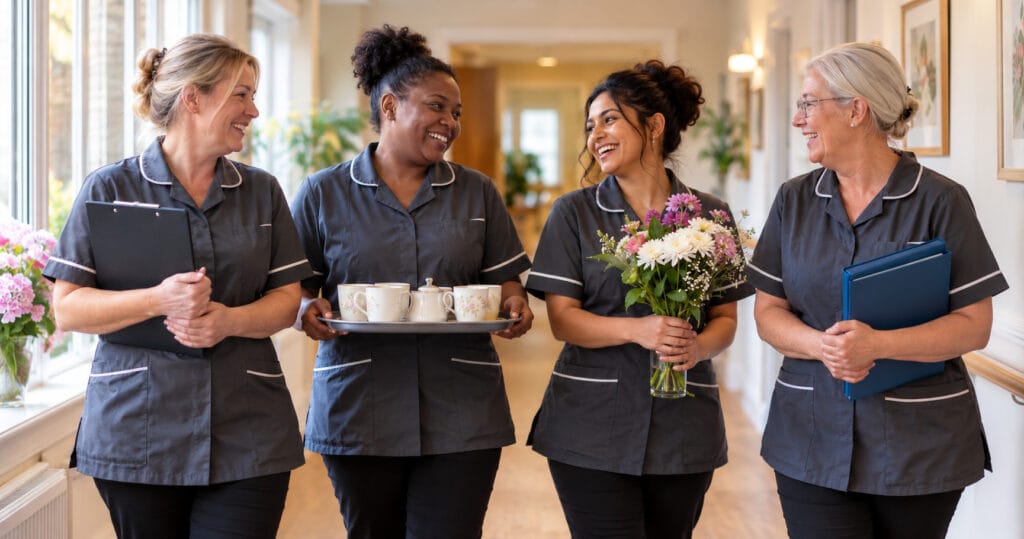
When people picture “the staff” at a care home, they often picture one undifferentiated group: kind, busy, slightly interchangeable. It’s an understandable shorthand, but it misses something that matters. A care home runs on a team of genuinely distinct roles, each requiring its own skills, and each contributing something different to a resident’s day.
Getting to know who’s actually behind the word “staff” is a reasonable thing to want before trusting a place with someone you love.
Leading the home: the Registered Manager
Every care home has a Registered Manager, who carries overall responsibility for how the home runs: regulatory compliance, staff management, and making sure the environment stays safe and welcoming. Families often meet this person at key moments, such as during the initial visit, at admission, or if a concern needs raising.
Hands-on care: Senior Carers and Carers
Senior Carers lead the day-to-day caregiving team. They develop and help implement individual care plans, oversee medication, and supervise the wider team of Carers, usually alongside a process of regular reviews to keep each resident’s care accurate and up to date.
Carers themselves provide the direct, daily support residents rely on most: help with personal care, mobility, and the small moments of company and conversation that make up much of a resident’s day. It’s often Carers who build the closest relationships with residents over time, simply through consistency and familiarity.
Behind the scenes: cooks and domestic teams
A good care home’s kitchen isn’t an afterthought. Cooks plan and prepare meals tailored to individual dietary needs and preferences, working closely with the wider care team so that nutrition and personal taste are both properly considered.
Domestic teams, meanwhile, keep the building clean, hygienic and comfortable. It’s unglamorous work that residents and families alike would notice instantly if it stopped happening well.
Enriching daily life: the Activities Coordinator
An Activities Coordinator plans and runs the recreational side of daily life: arts and crafts, music, gentle exercise, and anything else that keeps days varied and genuinely engaging, tailored as far as possible to individual interests rather than a single fixed programme for everyone.
A team built around training and continuity
None of these roles exist in isolation from ongoing development. Staff across UK care homes typically undertake continuous training throughout their careers, covering everything from basic care skills to more specialist areas like dementia support, not a one-off induction that’s never revisited.
Getting to know the people, not just the roles
This overview is deliberately general: a starting point rather than the full picture. Over the coming months, we’ll be publishing deeper features on several of these roles individually, including the people who actually do them. If you’re weighing up residential care for a relative, understanding the shape of a typical team is a reasonable first step before meeting the specific people who’d actually be looking after them.
If you’re considering a career in care yourself rather than researching it for a relative, several of these roles are ones you might want to explore in more depth.